Overview
What is Arcane OS?
A plain-language introduction to Arcane OS, its intent-and-capability model, current implementation, and development-only boundary.
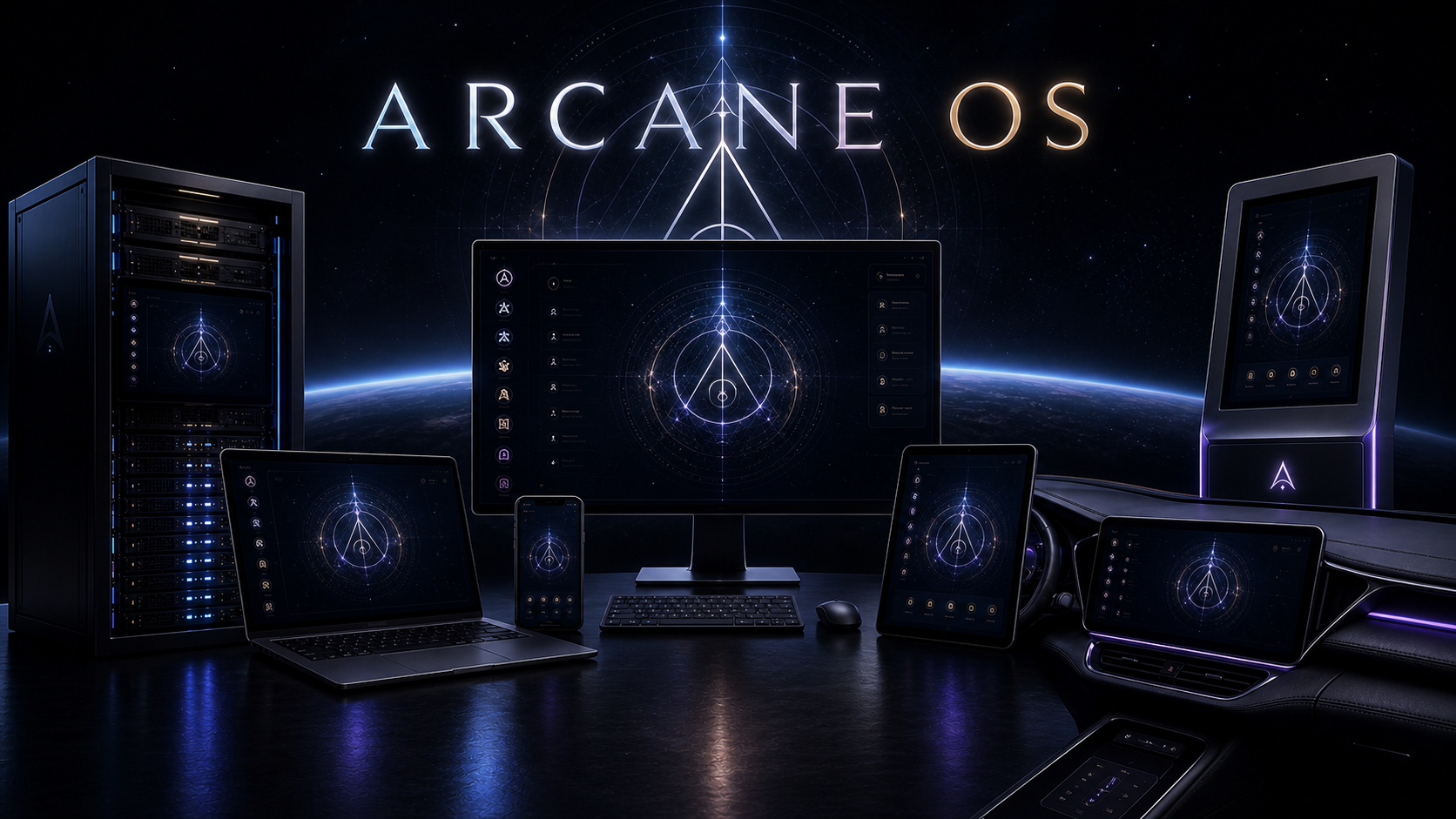
Arcane OS is a development-stage operating environment for human and artificial-intelligence collaboration. It is designed around a person's goal, the context needed to understand that goal, and explicitly governed capabilities that can act on it.
It is not a chatbot placed over a conventional desktop. The longer-term product direction is an environment in which a person can express an intent and Arcane can assemble the right approved applications, data, models, interfaces, and system operations while keeping sensitive actions visible and accountable.
Development status: Arcane OS is not a public release. There is no production or staging environment, no public installer, and no production-signed build. The published site documents current development work; it is not release or deployment evidence.
What makes Arcane different
- Intent before navigation. People should not have to translate every goal into a memorized sequence of applications and menus.
- Capabilities before arbitrary execution. Applications request typed, declared operations rather than silently acquiring broad machine authority.
- Policy before sensitive action. Planning and action can be permitted, constrained, confirmed, denied, redacted, logged, or escalated through explicit policy hooks.
- Human accountability. Important actions should remain attributable, reviewable, and appropriate to the current user's role.
- Scoped memory and data. User, application, machine, organization, and policy state are treated as separate scopes.
- Replaceable boundaries. Renderers, AI providers, storage providers, and host operating systems sit behind defined contracts instead of defining Arcane itself.
- Accessible adaptation. The interface is intended to adapt to a person's context and preferences without defeating semantics, keyboard use, contrast, or assistive technology.
How the current system fits together
Arcane applications use a shared interface runtime and a narrow window.Arcane application API. Arcane Core brokers declared capabilities and communicates with a native host. The host delegates low-level work to the underlying System Platform, currently Microsoft NT or experimental Linux implementations.
Person and intent
        |
        v
Arcane experience and applications
        |
        v
Governed capabilities and policy
        |
        v
Arcane Core and native host
        |
        v
Microsoft NT, Linux, or another system platform
The operating system underneath Arcane still owns drivers, accounts, process isolation, access controls, and hardware access. Arcane does not treat model output or a prompt as an authorization boundary.
What exists today
The repository contains a shared browser-context application runtime, reusable components and modules, a 21-application development catalog, native Microsoft NT hosts, experimental Linux hosts, and an experimental Android launcher foundation. These surfaces have different verification levels and should not be treated as one finished product.
For the precise boundary, read Capabilities and current status. To see the current catalog, open Arcane applications.
Choose a path
- Explore the idea: continue with Capabilities and current status and the glossary.
- See what is in the system: browse Arcane applications.
- Try the available development surfaces: read How to try Arcane OS.
- Join the engineering work: start with Developer setup, then Build your first Arcane application.
- Understand access limits: read Repository and download access.